My life has a superb cast but I can't figure out the plot.
~ Ashleigh Brilliant


Showing posts with label Wildflower Wednesday. Show all posts

Wednesday, July 14, 2010

Wildflower Wednesday


Home again, home again, jiggedy-jig!

We had a great vacation, but I'm finding it awfully hard to get back into anything resembling a routine. My mind's still locked in vacation mode and refuses to accept that break's over!

I've got over 300 photos - after culling a bunch - from our trip, and though I obviously won't be posting but a fraction of them, it's still going to take me quite a while to choose, edit and upload them and write my vacation posts. So meanwhile, I'll do my best to resume Wildflower Wednesdays between deck-staining and hay-hauling (break's definitely over!)

@~>~ @~>~ @~>~ * ~<~@ ~<~@ ~<~@

No one can have a healthy love for flowers
unless he loves the wild ones.
~Forbes Watson

So many of our wildflowers come and go so quickly, I've had an impossible time posting about most of them while they're actually in bloom. But Monday when I took the girls for our first hike since returning home, several of my favorite wildflowers were blooming that hadn't been when we left and it's inspired me to squeeze in at least one timely wildflower post, though I plucked the first two photos from my archives in the interest of time and my quickly shrinking hard drive space. (This post will take longer to load than usual, since my new camera takes "bigger" - but better - photos!)

So without further ado, here are a few examples of just some of what is currently blooming in our "backyard" (landscaped by Mother Nature, Master Gardener!) :-)

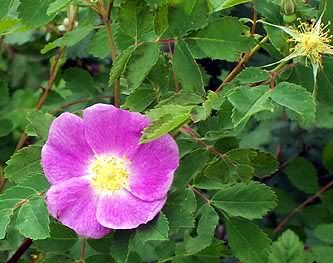
Wild Rose

Rosa woodsii
(aka Fendler Rose)

What can I say about the beautiful Wild Rose that you don't already know? It smells divine, produces loads of Vitamin C-rich rose hips (that I nibble on during fall hikes and pluck to bring home to Val and Tino the mice), and it grows here like gangbusters. In fact, it has completely overrun our little patio garden, crowding out our strawberries and threatening to overtake our Russian Sage, but we're happy to let it since now the patio smells like attar of rose. :-)

Sego Lily
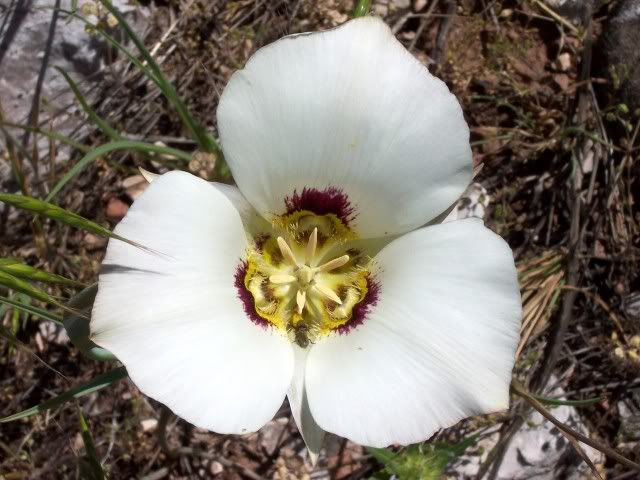
Calochortus nuttallii
(aka Mariposa Lily, Star Tulip, Butterfly Tulip)

The name Sego is of Shoshone origin, and the Sego Lily is the state flower of Utah. Its walnut-sized bulbous root is nutritious and sweet, edible cooked or raw, and when boiled tastes like potatoes. Rodents and bears eat it, Native Americans ground it to make bread, and the first Mormon arrivals to Utah depended on it during their early lean years. These lilies first started blooming in early June, and we have a real bumper crop of them now!

Harebell

Campanula rotundifolia
(aka Bellflower, Scotch Bluebell)

This plant looks different in the various environments in which it grows, and so has several names. Around here this plant is called a Harebell (I have no idea what the relationship to hares might be!) The flowers here called Bluebells are blue, not violet, bloom much earlier in the Spring, and have very different - and tasty - leaves (as you may recall from my grazing post). This same Harebell plant grows in Scotland, but much taller in the moist soil there.
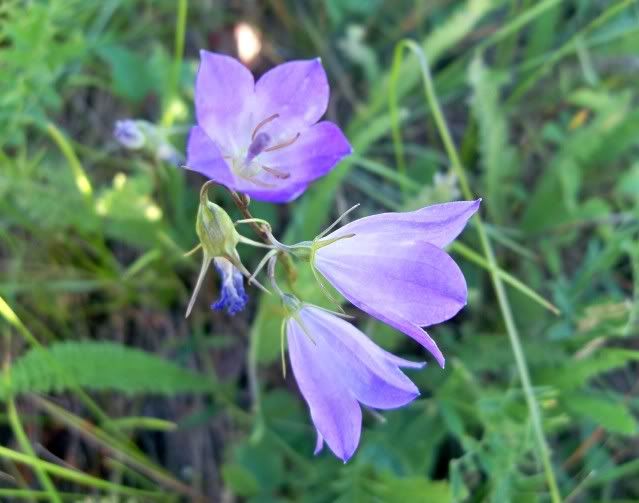

That delicate-hued trio of harebells was just too sweet to leave out of this post!

Wild Bergamot

Monarda menthaefolia
(aka Horsemint, Bee Balm, Lemon Mint)

Look closely, and you'll see a whole crop of Wild Bergamot in the background of this photo!

Funny that it's commonly called Horsemint, since horses are just about the only grazing/browsing critter who don't care for it! It may not be much to look at - lovely color, but looks like a bad hair day - but what it lacks in tidy beauty it more than makes up for in fragrance. Menthaefolia means "mint-leaved," and both the leaves and the flower release their heavenly spicy-minty fragrance when pinched or crushed. This flower attracts bees, hummingbirds and butterflies, so is popular in gardens. It's supposed to improve the health and flavor of tomatoes when planted with them. You may know bergamot from Earl Grey tea, and in addition to brewing up a fragrant cup of tea the leaves can also be used for flavoring in cooking (with a taste similar to oregano) and in simmering potpourri. The plant also has several medicinal uses, including as an antiseptic. But most importantly they provide delicious aromatherapy during my hikes. :-)

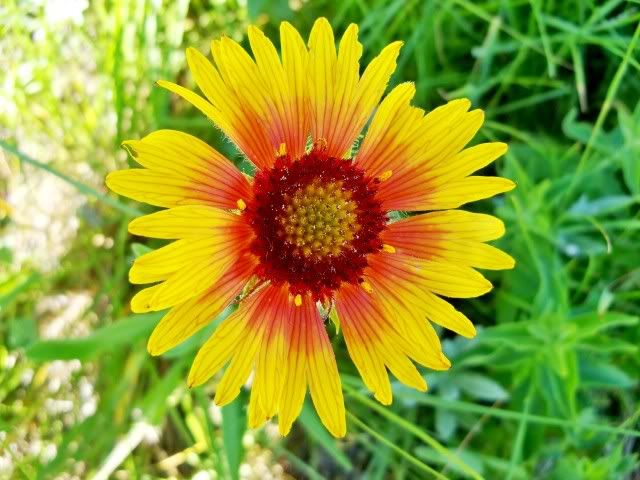
Blanketflower
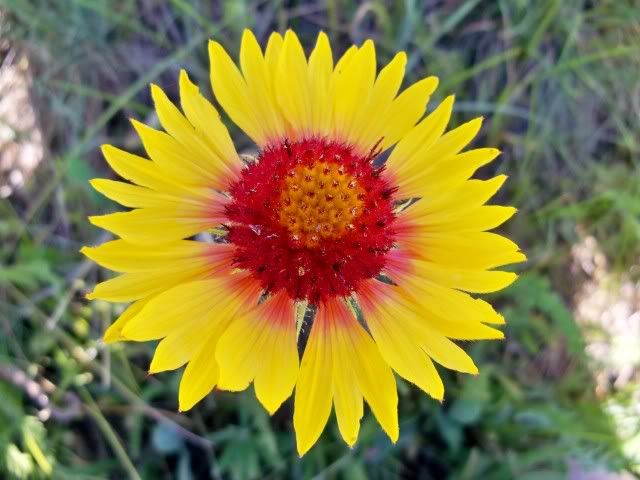

Gaillardia aristata
(aka Indian Blanket, Brown-Eyed Susan)

Aristata means "bearded." The Gaillardia has been domesticated, so you may recognize it from gardens. Matter of fact, BW once grew some from seed when we lived down in Buffalo and won a red ribbon for them in the Johnson County Fair. :-) They don't always have red on their petals, but the ones that do are my favorites. I couldn't decide which of these to post, so I went with both. The first one is such a perfect flower, and the other has such great color!

Long-plumed Avens

Geum triflorum
(aka Prairie Smoke, Oldman's Whiskers)

An adorable member of the Rose family. The photo above is what they looked like in June. The photo below is what they look like now when they've gone to seed, inspiration for the lovely name Prairie Smoke...
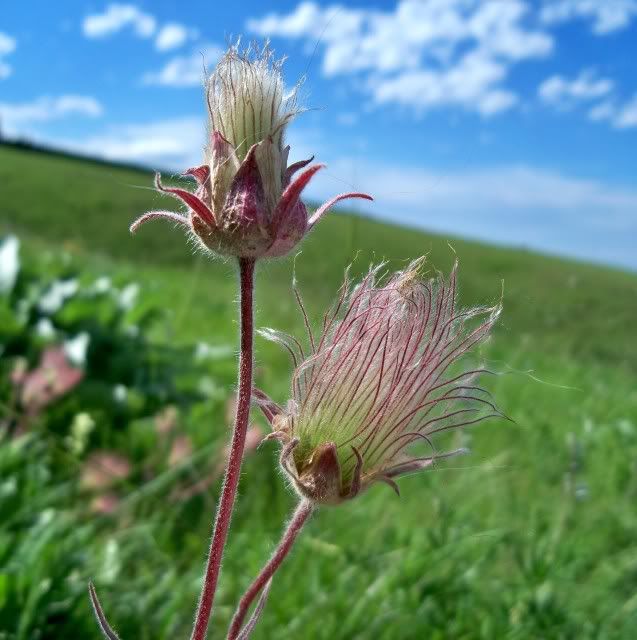

I just love them in this stage, with their wild Don King hair!
:-)

Sticky Geranium
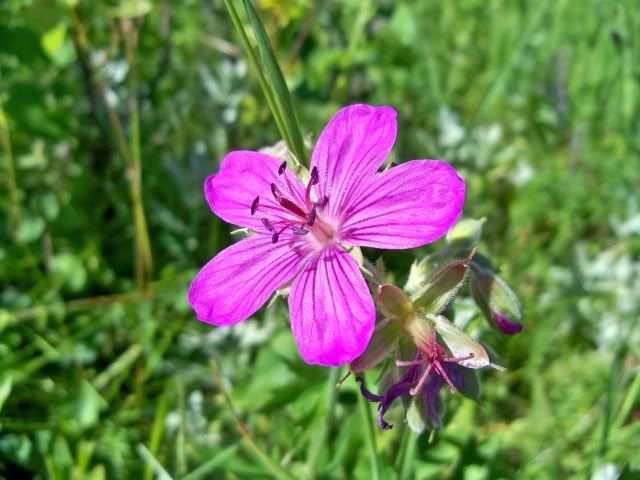
Geranium viscosissimum
(aka Pink Geranium, Cranesbill)

A main food source for several wild animals from elk to bears, the wild Sticky Geranium is in the same family (but different genus) as the household geraniums with which you are no doubt well acquainted!

Indian Paintbrush
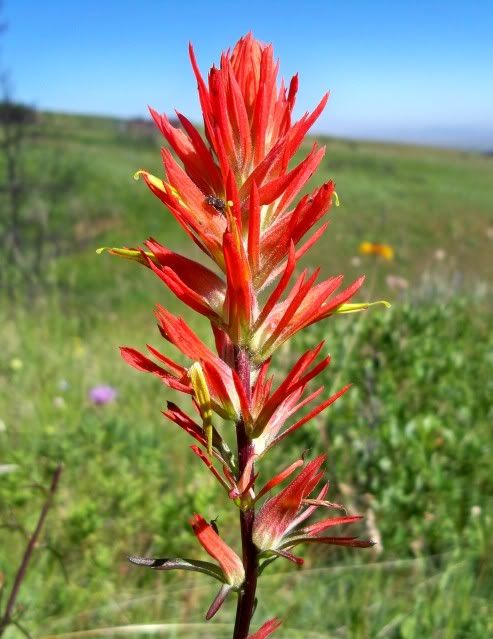
Castilleja linariaefolia
(aka Wyoming Paintbrush, Painted-cup)

(Note the Harebell blooming behind it on the left, and Blanketflower on its right!) As you may guess from one of its common names, the Paintbrush is Wyoming's state flower. It's also a semi-parasite, growing its roots through the soil until they penetrate the roots of nearby plants to steal some of their food! (Never trust a Wyomingite, I tell ya!) Sure are a pretty color though, and their name is appropriate because they not only look like a paintbrush, they paint the landscape a brilliant orange-red when they're blooming.

Wednesday, June 23, 2010

Wildflower Wednesday


The flowers of late winter and early spring
occupy places in our hearts well out of proportion to their size.
~Gertrude S. Wister

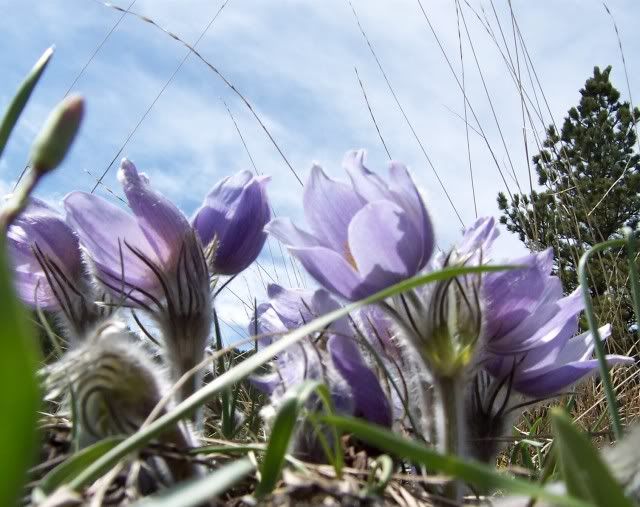
Some of our first arrivals, these beautiful-but-tough early bloomers show up while there is still snow on the ground (and in the forecast!)

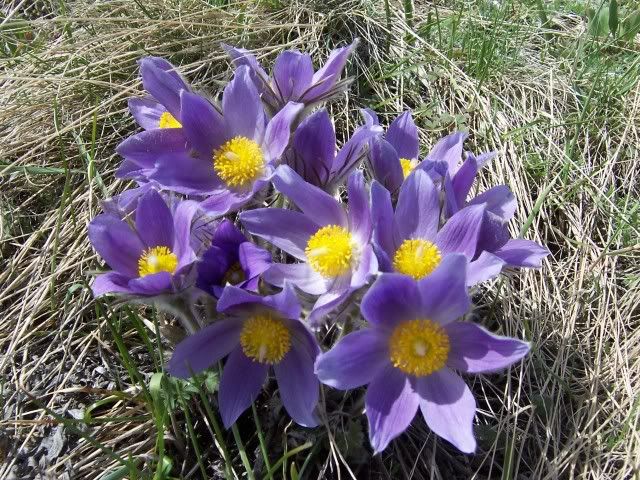
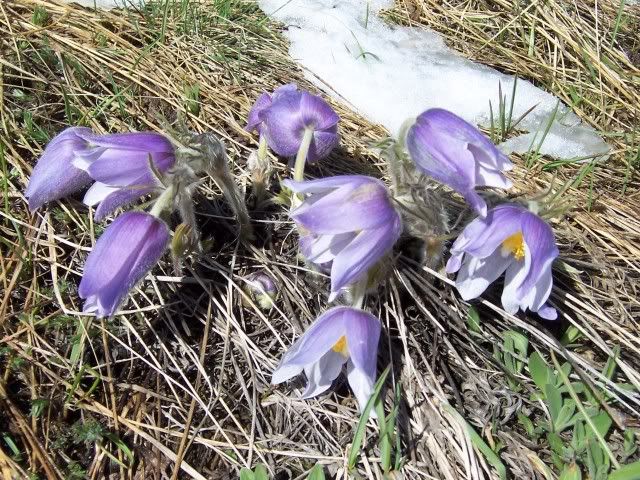
Common Pasqueflower (Pulsatilla patens)
aka Wild Crocus, Prairie Crocus, Prairie Anemone, Windflower...


The Pasqueflower typically blooms around Easter (hence the name), though this year it bloomed about a month late, and in great profusion. (Patens is Latin for "spreading," and they certainly have been!) :-) Because it grows at subalpine elevations (between 4000 and 9000') and blooms so early, its (usually) purple blossoms often create a lovely contrast against the snow...


I think it pisses God off
if you walk past the color purple in a field somewhere
and don't notice it.
~Alice Walker, The Color Purple


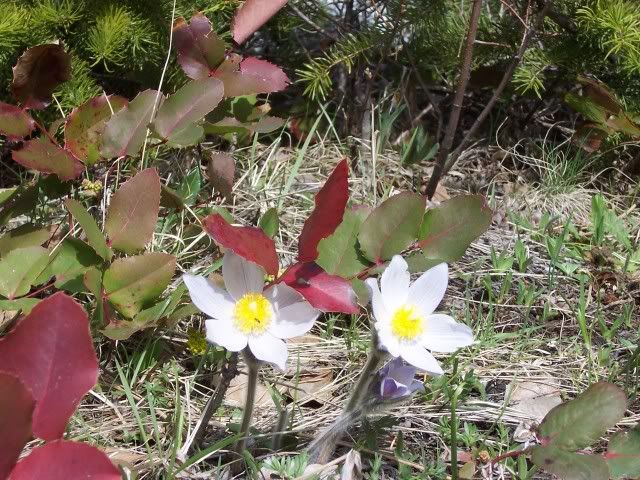
Pasqueflowers with Holly-Grape (Mahonia repens)
aka Oregon Grape, Mountain Holly, Creeping Barberry
(Repens means "creeping")...


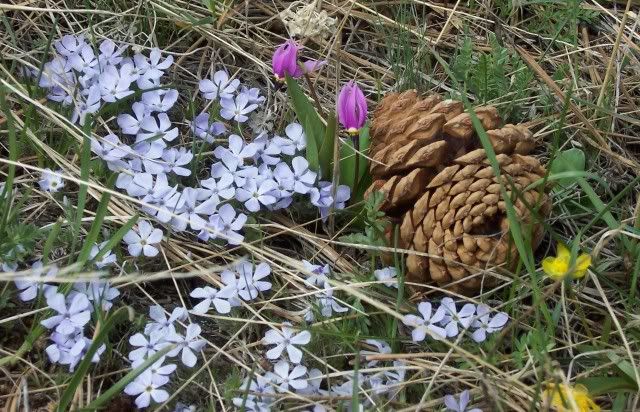
Shootingstars (Dodecatheon pauciflorum)...


This is one of my favorite wildflowers, and one of the first signs of spring for me. I love the name Shootingstar, which describes it better than its scientific name (Dodecatheon pauciflorum comes from two Greek words meaning "twelve gods" and "few-flowered.") These rugged little buggers have been found growing at nearly 12,000' elevation, and around here they survive being buried under heavy spring snows. Don't let their delicate beauty fool you!

Phlox, Shootingstars, and a pine cone :-) ...


Phlox (Phlox multiflora) is one most flower gardeners are familiar with. The many varieties of cultivated phlox found in flower beds were produced from wild species, of which there are 45 native to North America and China (about half of them in the Rockies).

The wee yellow flowers just visible in the above photo are...

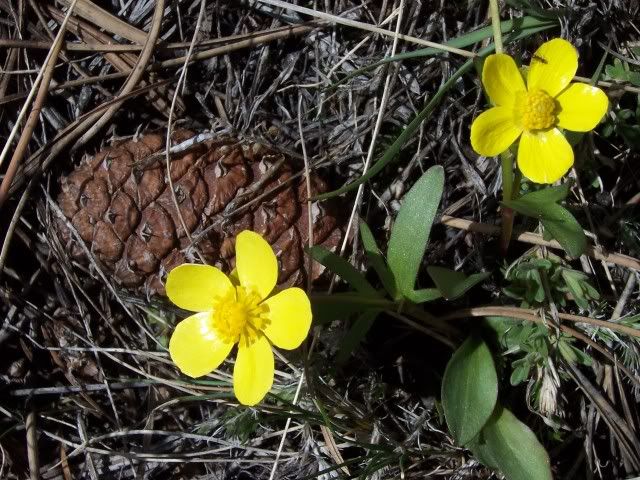
Sagebrush Buttercups (Ranunculus glaberrimus)...


Ranunculus means "little frog," glaberrimus means "smoothest." Another name for this early buttercup is "Crowfoot." As a group (of which there are about 300 species, 40 of them in the Rockies), buttercups are toxic, but the Sagebrush Buttercup is an important spring food for the blue grouse.

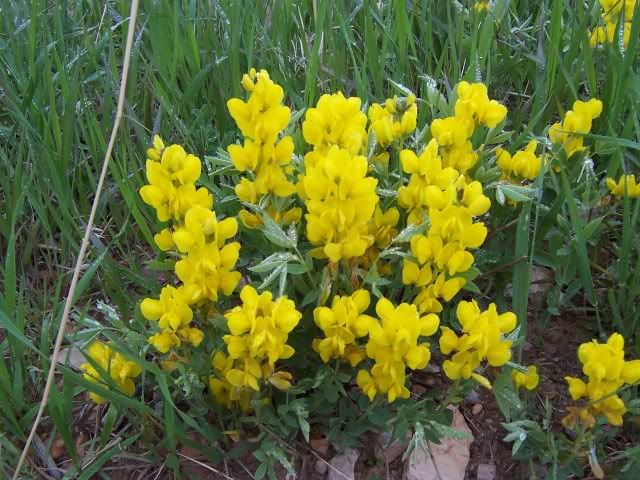
False Lupine (Thermopsis montana)
aka Golden Pea, Goldenbeans, Buffalo Pea...


Between snows, early spring here is a riot of bright yellow thanks to the False Lupine (a member of the legume family) that blankets the ground and lasts well into June. It's showy and hardy, but poisonous.

Yellow Fritillary (Fritillaria pudica)
aka Yellowbell...


Another of my favorite wildflowers, the Yellow Fritillary (of which there are only three species) reminds me of a little desk lamp with a pretty stained glass shade. :-) I just regret that my best photo of one came out blurry. By the time I got my new, better-focusing camera, these dainty little blossoms were long gone. They show up early, but their stay in their bright yellow spring attire is very brief (they turn a dull red not very long after blooming). Their fleeting visit, along with their always downward-cast faces, no doubt inspired their Latin name; pudica means "bashful." :-) Not all yellow early spring wildflowers are poisonous - the Yellow Fritillary is edible. The green seed pods are reportedly delicious eaten raw or cooked, and the fleshy, starchy corm (the part from which the plant grows) is said to taste like potatoes when eaten raw, like rice when eaten cooked. Not that I'd know - I wouldn't want to munch on such a brave, pretty and bashful wildflower! :-)

*****************

A couple of notes...

I read the beautiful book Planthropology by Ken Druse during the winter, and highly recommend it to everyone, but especially to those of you interested in (or completely besotted by) flowers, plants, gardening, plant photography, natural history or plant biology. His photography is breathtaking, and you can see examples of it and of his beautiful gardens on his web site. Probably it was mental laziness, but I've always ignored learning the scientific names of plants in favor of their common nicknames. But Mr. Druse strongly encourages learning their botanical names, and explains some of the more common, descriptive Latin (or "Latinized") words used. He convinced me, so now I'm learning some basic taxonomy - family, genus and species names - of my favorite wildflowers, which is why I'm including their genus and species names in italics in these posts. (My tattered 1963 edition of A Field Guide to Rocky Mountain Wildflowers has been very helpful!)

And speaking of these Wednesday Wildflower posts, this will be the last one for a while. I'm not sure when I'll be able to resume them, but will as soon as time allows. I have quite a few left to share!

Wednesday, June 16, 2010

Wildflower Wednesday


Deep in their roots, all flowers keep the light.
~Theodore Roethk

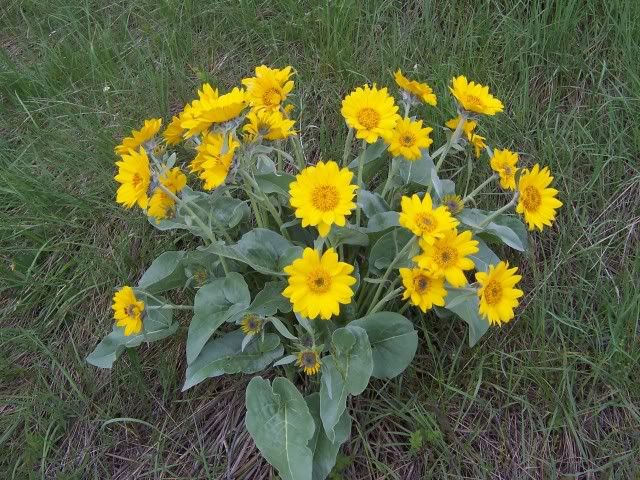
Arrowleaf Balsamroot (Balsamorhiza sagittata)

With huge leaves clearly shaped like arrows (sagittata means "arrow-leaved"), and roots containing sap that smells strongly like balsam pine, you can see how this plant got its name. Closely related to the sunflower, the Balsamroot's flowers can reach heights of almost two and a half feet while the leaves are often as big as a foot long and 6 inches wide. They blanket the hillsides with their bright yellow-gold color, and since they bloom here along with the lupine (and many other wildflowers), it makes for very colorful late spring/early summer meadows.


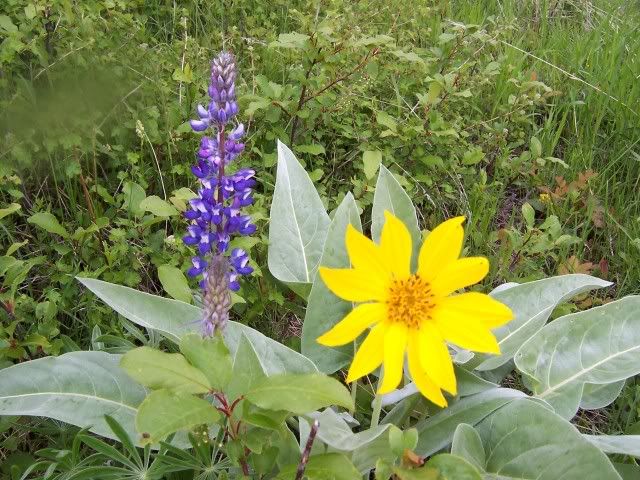
Lupine and Arrowleaf buddies
(and an accompanying raindrop smear on my lens!) :-)
If we could see the miracle of a single flower clearly,
our whole life would change.
~The Buddha


The flowers, about 3-4" across, are apparently quite tasty, since Mocha loves to eat them! He's not alone, as the leaves and blossoms are the preferred springtime food of Bighorn Sheep. Elk and deer enjoy the tender young shoots, and Native Americans ate the roots, sprouts and seeds and used the leaves, sap and roots to treat various wounds and ailments (all parts of the Arrowleaf Balsamroot are edible, and its sap has anti-bacterial and anti-fungal properties). Fortunately, this plant can easily withstand heavy grazing!


As well as heavy romping, as Tess joyfully demonstrates. :-)


Wednesday, June 9, 2010

Wildflower Wednesday


"It was the best of times (for blogging),
it was the worst of times (for blogging)."
~ Laloofah (with help from Charles Dickens) ;-)

It's the best of times because I've got the most stuff going on to blog about. It's the worst of times because I've got the most stuff going on so almost no time for blogging! This season of nice weather is brief and frantic here... seems we cram about 8 months' worth of projects and activities into two! And this year has more going on than most.

It's also the best of times for blogging because it's the most photogenic time of year here. And this has been one of the most amazing years for wildflowers we've ever seen, so I've been taking a lot of wildflower photos since April with the intention of doing a "wildflower safari" post. But even though I've had to delete most of my pictures because my worn out little Kodak can no longer handle close-up focusing, I still got enough worth keeping that it'll take a lot more than one post to share the best ones. So I decided to try a Wildflower Wednesdays theme, featuring just one or two wildflowers each week that I can manage it, and for as long as it takes ~ even if by the time I get them all posted, there's nothing but snow where the wildflowers once bloomed! (And maybe this will keep my blog from going completely dormant till Labor Day!)

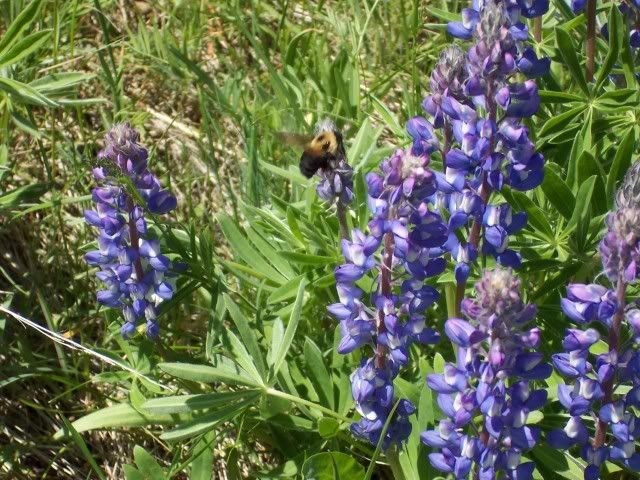
Let's begin with our lovely local Lupines, since they are at their height of beautiful blooming abundance right now...


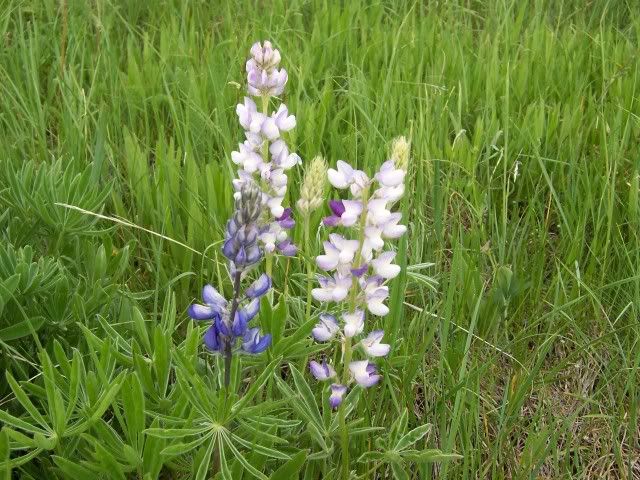
There are more than 200 wild species of Lupine, mostly in North and South America but also in the Mediterranean, with about 50 species here in the Rocky Mountain region. The species are often difficult to tell apart, and I have no idea which ours is (or are), but while the flowers are mostly a purplish blue color, they can vary from white to light blue to dark blue to pink to different shades of purple.


The one above is a real showoff, with four colors going on one plant! We saw our first all-white one on a hike last weekend, but did I have my camera with me? Alas, I did not. *sigh*


See the bee in the upper middle of this photo? I've been chasing bumblebees from plant to plant all over the mountainside, trying to get a good photo of one! It's harder than I thought, the bees probably think I'm a lunatic, and I absolutely decided I need a new camera that can take close-ups, among other things. So we ordered one yesterday. :-)

As a bee gathering nectar does not harm or disturb
the color and fragrance of the flower,
so do the wise move through the world.

~The Buddha, Dhammapada: Flowers, verse 49

~~~~~~~~~

Speaking of wise, non-harming bees, here's a cute one who was a lot more cooperative about posing for a picture! :-) I took this of BW (aka Bee Dub) on his birthday Sunday. I think he looks a lot younger than 51 (and I'm not just saying that because he's my sweetie!) ;-)


This is what he was looking up at... some interesting clouds building on top of the 8000' high Moncrief Ridge behind our house. He thought this cloud looked like a dragon, sprawling along the top of the ridge...


And lest you think I've gone off on a completely non-wildflower tangent... see all that yellow in our pasture and beyond? Those are Arrowleaf Balsamroot flowers, which always bloom along with the lupine. So maybe they'll be the next Wednesday wildflower! :-)

~~~~~~~~~~~

P.S. I can seldom hear the word "lupine" without thinking of Monty Python's Dennis Moore, the inept Robin Hood character who steals lupines from the rich to give to the poor...


I always crack up at the "Shut up! This is a holdup, not a botany lesson" bit!

LinkWithin

Related Posts Plugin for WordPress, Blogger...

SOME CURRENT & RECENT READING...

SOME CURRENT & RECENT READING...

  • THE HUMANE GARDENER ~ Nancy Lawson
  • THE WORLD WITHOUT US ~ Alan Weisman

There is still strong in our society the belief
that animals and the natural world have value
only insofar as they can be converted into revenue.
That nature is a commodity.
And that the American dream is one of unlimited consumption.
There are many of us, on the other hand,
who believe that animals and the natural world
have value by virtue of being alive.
That Nature is a community to which we belong
and to which we owe our lives.
And that the deeper American dream is one of unlimited compassion.

~John Robbins, "The Food Revolution"

free counters